AN: – Please tell us how you are acting to help the refugees from Ukraine.
AM: I’ll start with the beginning, as they say. On the 24th of February, around 10 am, I started receiving phone calls from the media, with the request to inform them about the situation at the Isaccea border crossing point. Initially, until 19 o’clock, the flow of entry into Romania was normal, but after that, the number of those who crossed the border to take refuge from the war began to increase exponentially. From that moment on, we started preparing by mobilizing the mayor’s staff to receive the refugees.
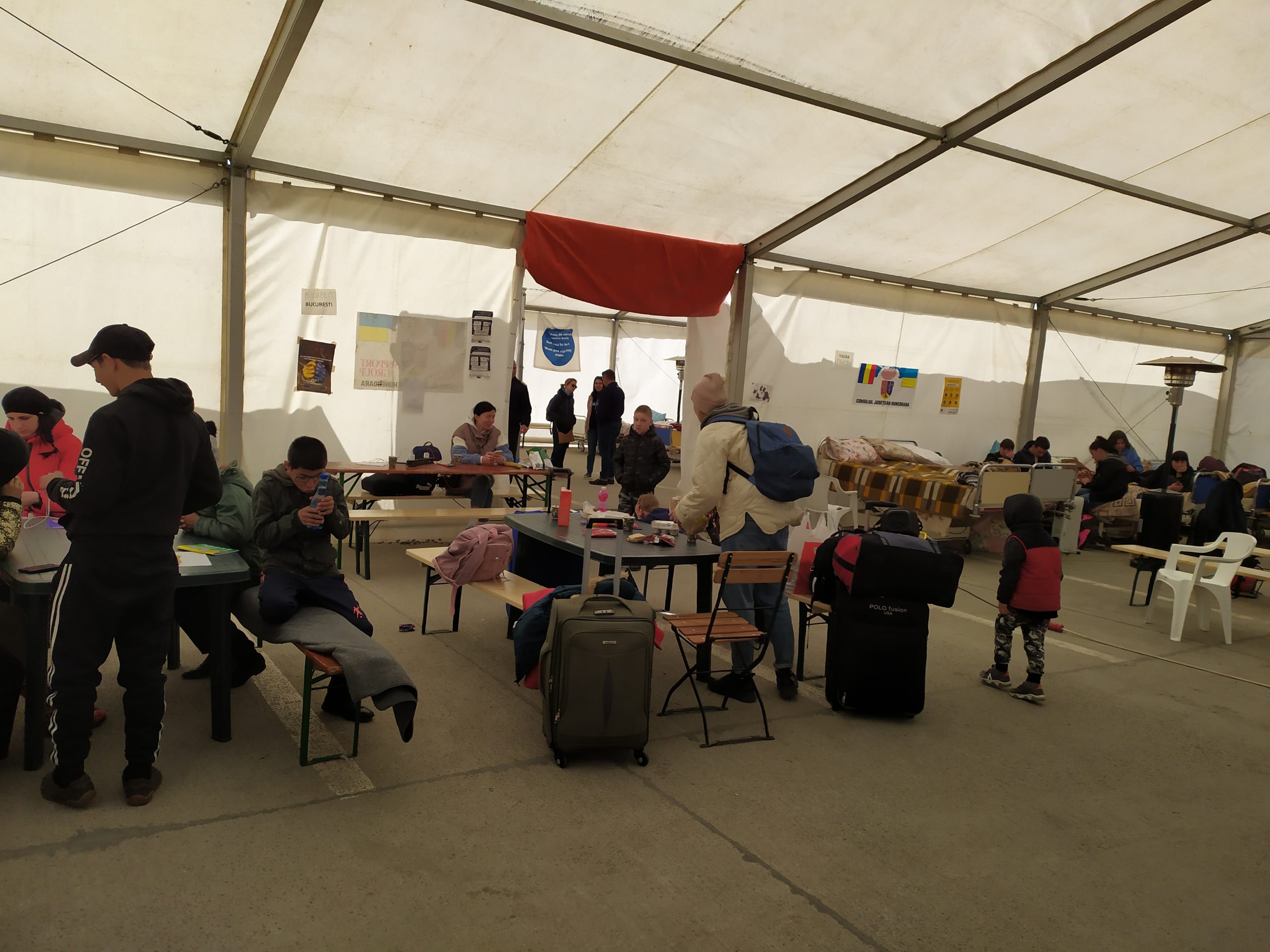
In the first two days, more people passed by car, but then about 700 people went to a ferry race and about 3,000 people a day. Immediately, our partners from the Tulcea Inspectorate of Emergency Situation „Delta” came with tents, then the representatives of the „Red Cross” and the non-governmental organizations arrived. The volunteers did a great job, without them I don’t think we could have done it. Russian-English translators came first, they had gone through such experiences and taught us what to do.
AN: – With which institutions, organizations do you coordinate your efforts? How did people in the community react to the needs of Ukrainian refugees?
AM: As mayoralty, we have put at the disposal of the refugees all the materials and financial resources available. I must admit that for the first two weeks after the start of the war, with the exception of electricity and sewage at the customs point, all the expenses of the refugees were taken over by us, namely: food, food preparation, hygiene products, etc. The biggest expense was the cost of transportation of refugees, until the Government Emergency Ordinance came to be. It stipulates that the transport of refugees is paid for by the county councils. That’s right, I also got help from some companies. The accommodation of the refugees was provided in the school gym.
At one point, a major problem was the management of aid: a huge amount of aid came to us, and we provided all the appropriate spaces: kindergarten, synthetic sports fields and we also turned to companies that helped with storage space.
Then we started dispatching aid, and I remember that the first two trucks left for Kyiv, which was under siege at the time.
For the first two weeks, the entire community in Isaccea was extremely demanded by the wave of refugees. We stayed at the border crossing 24 hours a day with our fellow citizens. Some of them helped and continue to help at the humanitarian hub by preparing food or receiving refugees in their homes.
Everything done for the refugees was a team effort, a team of kind people from our community, state institutions as Tulcea Inspectorate of Emergency Situation „Delta”, Tulcea County Council, international organizations as the „Red Cross”, NGOs, and volunteers from the community.
We also coordinated our efforts with the Turkish Consulate in Constanța, which came and took over about 1,000 Turkish, Moroccan and Turkmen refugee students from Ukraine. NGOs took people directly from the Isaccea border crossing to wherever they needed: Constanța, Bucharest …, they also helped them solve the problems with their travel documents.
Now, we still have 70 people accommodated in Isaccea, for whom we also provide meals, but we also have a reserve space of 30 places for people who arrive during the night. This space was provided to us by the Baptist Church.
We also deal with a humanitarian hub, from where we send aid everywhere in Ukraine. We sent aid to Kyiv, Nikolaev, Odessa, Ismail, Reni, Mariupol. We are working closely with the Odessa Military Administration to send humanitarian aid where it is most needed.
We must also take into account the fact that many people have taken refuge in Ukraine, near the border with Romania, who, depending on the evolution of the war, can move to Romania, and we must be prepared. All these people need help, food, basic necessities.
In Ukraine it was very difficult at first: the trucks loading aid did not have fuel to return to Ukraine – we had to refuel them. Another time, 5 trucks came from the Odessa Emergency Situations Department, loaded the humanitarian aid, but we had to pay the ferry fee for them to return. It was 1 o’clock at night …
Yes, we had huge expenses at the mayor’s office, but I have to admit that civil society is doing its job very well.
AN: Do you think that the experience of cooperation with Ukrainian organizations mattered? Have you kept in touch with your Ukrainian partners? How do you see the continuation of the projects you are implementing?
AM: We struggled a lot for this border crossing point, that’s why I got in a lot of contact with our partners from Ukraine: Orlivka, Ismail, Reni … and the cross-border projects we have in implementation have been very welcomed because they are complementary with our soul project: the Isaccea-Orlivka border crossing point. We also have a special connection with the Odessa Military Administration.
We have built close partnerships in cross-border projects, we communicate a lot and we are all confident that we will be able to successfully complete our projects. I think this war brought us closer together, we got to know each other better. We look forward to seeing the end of the war so we can meet each other.
We know that the partners in Ukraine are carrying out those activities that they can do now, given the circumstances and restrictions on payments, and we in Romania are still working, we are in the final phase of the technical project and we hope that until May 15 we will be able to start the procurement for works in the frame of CBConnect Trans project.
The future sounds great for our partnership and we will definitely submit beautiful projects on the NEXT Romania-Ukraine Cross-border Programme.
AN: – Do you have a message for your Ukrainian partners?
AM: We pray for the ending of this war, and for those who started it to lose it! We wish for our partners to return home and have the power to rebuild everything that was destroyed!
AN: – When we made the film of the Joint Operational Programme Romania – Ukraine – Republic of Moldova 2007 -2013, your partner from the Ismail Local Council, Mr. Valentin STROIA ended his speech with the following words: „For me, it is a blessing to have been born at the border!” How is it for you?
AM: I am very happy that we managed to open this Isaccea-Orlivka border crossing, which, as many refugees say, was a gift from God to them.
And I, personally, subscribe to what Valentin said: for me, it is a blessing to have been born at the border!




 Română
  English (UK)
 Українська